
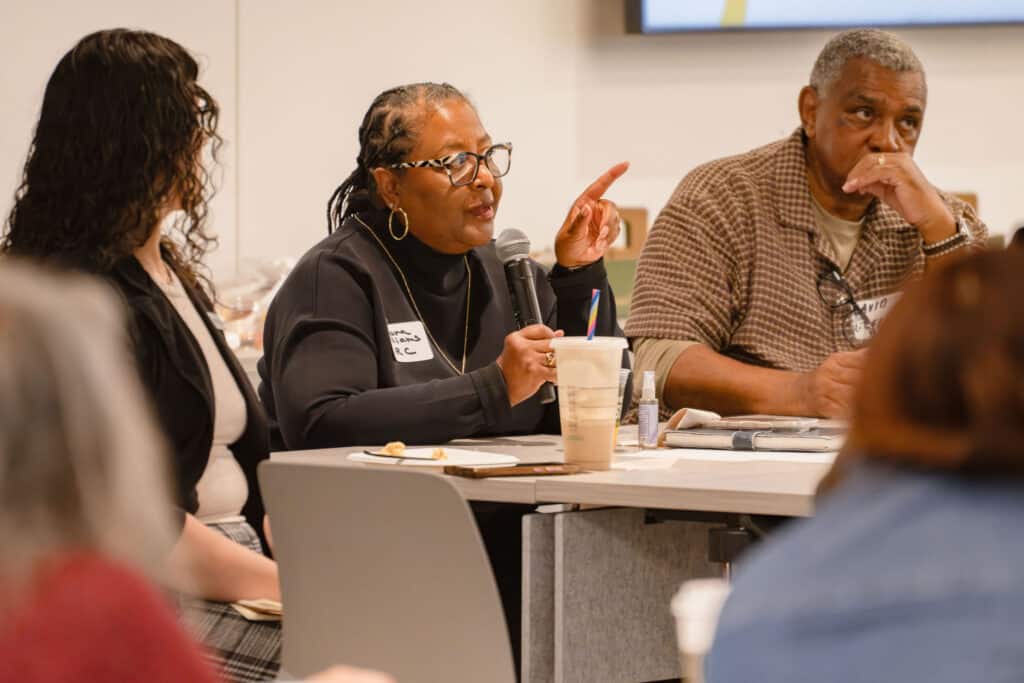
On April 28, 70 partners from across the Inland Empire Vital Conditions Network gathered at Riverside City College for a day of connection, reflection, and shared direction. We are grateful to Riverside City College for welcoming the Network and helping create space for this important regional conversation. The meeting invited partners to take up a big question: What would it take for the Inland Empire to move together around a bold north star goal for thriving?
The day grounded participants in the purpose of the Network: to reimagine collective action so all people and places in the Inland Empire can thrive — no exceptions. As a network-of-networks, IEVCN builds on the strengths of existing efforts, amplifies what is working, and discovers new ways to combine regional assets for greater impact.
Several themes rose to the surface throughout the day:
- the need for a clearer shared goal
- the power of belonging and civic muscle
- the importance of stronger local storytelling and information access
- the opportunity to distribute leadership so more partners can contribute to the work ahead
Telling a New Story of the Inland Empire
The morning opened with a focus on momentum for thriving together. Armando Carmona of the Inland Empire Journalism Innovation Hub + Fund invited participants to reflect on the role of local news, trusted information, and community storytelling in shaping the region’s future.

Partners named the stories they hope to read and hear more often — stories of reduced division, improved health, youth choosing to build their futures in the Inland Empire, thriving local businesses, stronger civic engagement, and communities defining success on their own terms.
“Everyone has a right to inform.” – Amando Carmona
Across the room, participants named a shared desire to reclaim and co-create a new narrative for the Inland Empire. While the region is too often defined by deficit, partners recognized that a different story is being built through what we do together — by strengthening partnerships, making progress visible, aligning investments, and shaping a future rooted in the region’s talent, creativity, and community power.
Building Belonging, Bridging, and Civic Muscle
Damien and Jennifer O’Farrell led participants through a session on bridging and weaving — practices that help communities respond more effectively to othering, division, and isolation.
A few key lessons stood out:
- Belonging is built through everyday practice. It grows when people are welcomed by name, invited to share what matters to them, and given real opportunities to shape decisions — not just respond to decisions already made.
- Bridging means staying connected across difference. It requires listening for shared values, asking better questions, and making room for disagreement without losing sight of one another’s humanity.
- Civic muscle grows when people act together. Partners can strengthen civic muscle by creating clear pathways for contribution — inviting people to join a workgroup, share a story, connect a partner, advocate for a policy, or help resource a shared priority.
- Weaving is how regional momentum spreads. Network partners can look for the people, organizations, stories, data, and resources that should be connected, then make the introduction, share the opportunity, or help others see where they fit.
This work reflects a core belief of the Vital Conditions framework: Belonging and Civic Muscle is both a condition for thriving and a practical capacity needed across every other area of change. Whether partners are working on housing, workforce, education, health, climate resilience, or local journalism, the ability to build trust and act together matters.
Exploring a Bold North Star Goal
A central focus of the day was the possibility of adopting a bold north star goal around thriving. Jasmine Hutchinson of Loma Linda University Health opened the conversation by inviting partners to consider the kind of goal that is both exciting and challenging enough to change how the region works together.
Rather than setting a goal that can be reached by doing more of the same, partners explored what it would mean to set a goal that requires new ways of working, clearer tradeoffs, deeper alignment, and greater focus on those who are currently struggling and suffering. Many affirmed that the Network’s existing aspiration — all people and places thriving, no exceptions — remains the right direction. The opportunity now is to make that aspiration more concrete, measurable, and actionable.
The conversation built on emerging approaches under discussion: the national Great Stride goal to increase thriving by 20 points by 2036, and the IE 2040 Regional Health Goal, which envisions an Inland Empire where residents across generations achieve optimal health and well-being and where regional thriving exceeds the national average.
Together, these frames invited partners to think about how the Inland Empire could align with a larger movement and reflect the region’s priorities, assets, and commitment to communities experiencing the lowest levels of thriving.
Partners expressed strong interest in a shared goal that is specific enough to guide action, flexible enough to align across Vital Conditions, and bold enough to meet the moment. They also raised important questions: What are our non-negotiables? How do we align with existing community-led efforts? How do we measure not only outcomes, but whether we are working together differently?
Distributing Leadership for the Work Ahead
The meeting closed by revisiting the Network’s emerging governance structure. As IEVCN grows, partners are exploring how to distribute leadership in ways that support coordination without becoming top-down.
The draft structure includes a Backbone Team to support alignment and infrastructure, an Engagement Workgroup to deepen partnerships and storytelling, an Impact Workgroup to guide data and shared sense-making, and Vital Conditions Teams to help partners organize around specific areas of change.
This structure is intended to help the Network move from shared interest to shared stewardship — creating clearer pathways for partners to contribute, lead, and connect their work to a broader regional movement.
What Comes Next
The April 28 gathering reinforced both the urgency and the possibility of this moment. Partners named real challenges — affordability, distrust, underinvestment, fragmentation, and political uncertainty — while also recognizing that collaboration is rising, relationships are deepening, and regional assets are in motion.
Next steps include continuing to refine the Network’s bold goal direction, finalizing the Network charter and governance model, and continuing to advance key strategies through existing and emerging IEVCN workgroups.
The path ahead will require shared language, shared measures, courageous experimentation, and deeper participation across the region. Most of all, it will require many people and organizations choosing to see themselves as stewards of a thriving Inland Empire.
Together, the Network is continuing to ask: What will it take for all people and places in the Inland Empire to thrive — no exceptions?